5 May 2026
Generative AI in healthcare: the gap between pilots and real impact

Solutions
Share with



Generative AI in healthcare is no longer experimental. In 2025, more than 80% of U.S. healthcare executives are testing generative AI in pre-production environments. Budgets are approved, pilots are underway, and adoption is accelerating. And yet, most teams are stuck in the same place.
The use of AI in healthcare is no longer the question. It’s already in documentation, triage, coding, and diagnostics. The applications of generative AI in healthcare are clear, and the early benefits of AI in healthcare — less admin work, faster workflows, more precise decisions — are already measurable.
So why does real impact still feel out of reach?
Because moving from a working pilot to a system that holds under pressure is a different problem entirely.
From what I see, most organizations underestimate this gap. Models and ideas are no longer the constraint. Integration, data quality, workflows, and the ability to run generative AI for healthcare inside complex, regulated environments without slowing everything down — that’s where things get hard.
In this article, I’ll break down what artificial intelligence in healthcare actually looks like today, where the role of AI in healthcare is already delivering value, and why scaling those results is where most teams lose momentum.
If you want to move beyond pilots and make AI work in real operations, this read is worth your time.
Table of contents
2026 market reality: generative AI in healthcare hits escape velocity
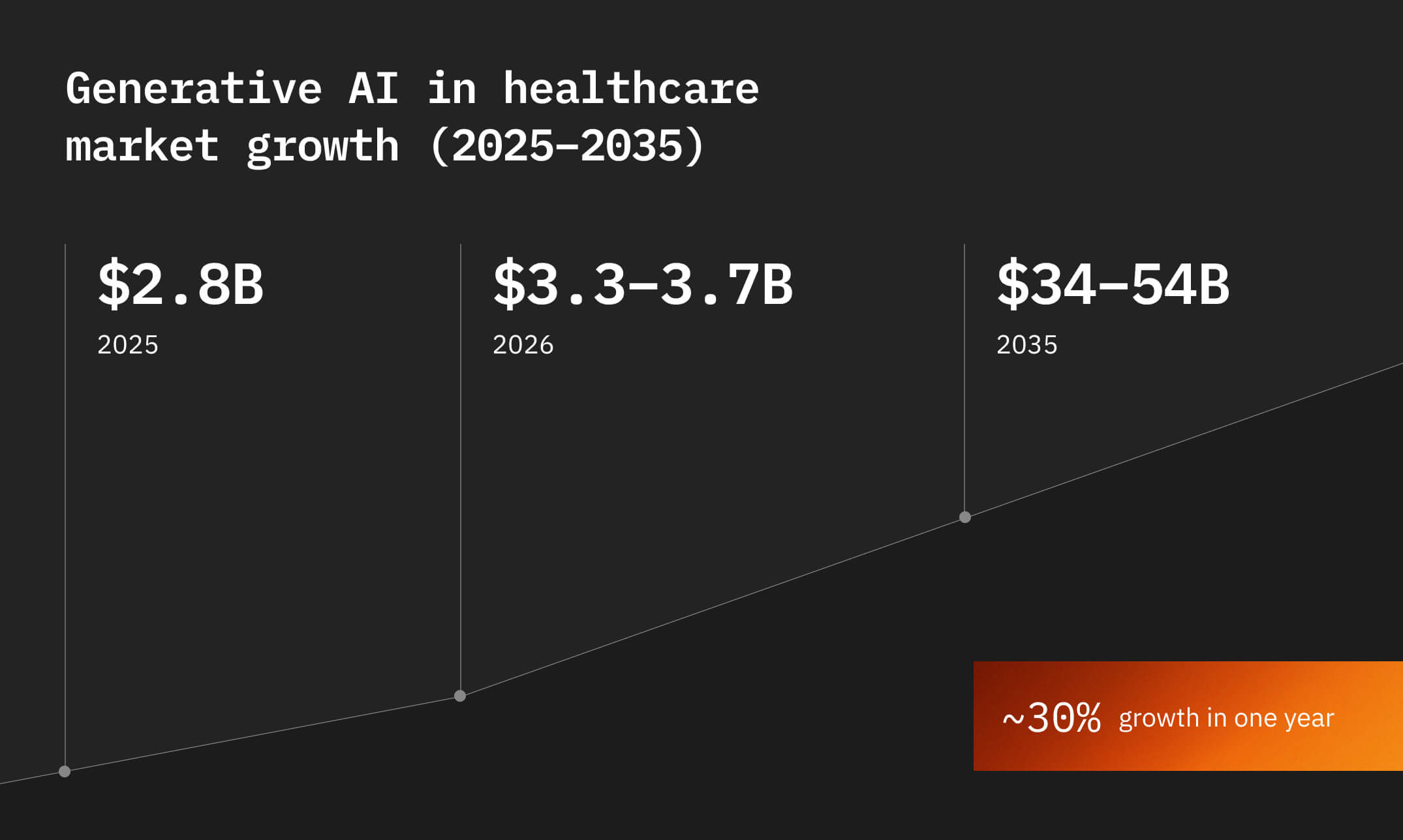
In 2026, generative AI in healthcare has moved past pilots. It is in production and growing steadily. The market is expected to increase from around USD 2.8 billion in 2025 to USD 3.3–3.7 billion in 2026 — roughly 30% growth. Looking ahead, projections reach USD 34–54 billion by the mid-2030s.
But scale is not the main story. Usage is. The use of AI in healthcare is already visible in clinical documentation, coding, prior authorization, and triage. These are practical applications of generative AI in healthcare, now embedded into everyday workflows. Ambient documentation tools inside EMRs are a clear sign of how generative AI for healthcare is becoming part of core systems.
The results are measurable. AI-assisted documentation reduces admin time by 20–30% in controlled settings. There is also less after-hours work and lower clinician burnout. These are tangible examples and real benefits of AI in healthcare, not projections.
Regulation is catching up. The EU AI Act, EHDS, FDA, and MHRA frameworks are turning the role of AI in healthcare into something structured and governed. This is no longer experimental tech but a regulated infrastructure.
This shifts the bottleneck. The question is no longer is AI being used in healthcare. It is. The challenge is execution — integrating, scaling, and maintaining these systems. That requires strong engineering in MLOps, data, and integration.
As a CTO, this is where I see most teams slow down. The impact of artificial intelligence in healthcare is clear at the use-case level. Scaling it reliably is the harder part.
Scale generative AI in healthcare with the right engineering partner
Move from pilots to production with secure, scalable generative AI in healthcare systems built around your workflows and constraints.

What artificial intelligence in healthcare looks like today
Artificial intelligence in healthcare is no longer a future concept. It is already part of day-to-day clinical and operational work, just not always evenly implemented.
Across Europe, North America, and emerging markets, the use of AI in healthcare is less about visible “robot doctors” and more about a quiet, data-driven layer supporting diagnosis, triage, documentation, and administration. In 2026, this layer is powered by a mix of machine learning, natural language processing, and increasing tools embedded into EMRs, imaging systems, and telehealth platforms.
This is what makes AI hard to spot and hard to replace. Once it works, it disappears into the workflow.
Where AI shows up clinically
In radiology and pathology, computer vision models assist with image analysis, detecting early-stage tumors, diabetic retinopathy, or subtle fractures. These are well-established examples of AI technology in healthcare, often performing at or above human-level accuracy in controlled settings.
In intensive care, predictive models monitor vital signs to flag risks like sepsis or cardiac events hours earlier than traditional methods. And in fields like oncology and cardiology, AI-powered decision-support tools help interpret complex genomic and biomarker data, supporting more personalized treatment plans.
These are not edge cases. They are core types of artificial intelligence in healthcare already in use.
Where AI shows up operationally
Automated documentation, coding, and triage are some of the most widespread applications of generative AI in healthcare today. Ambient documentation tools, for example, listen to clinician–patient interactions and generate structured notes.
Other tools handle prior authorization, clinical trial matching, and claims processing, reducing manual work and administrative overhead. At the same time, AI-powered assistants manage scheduling, patient communication, and follow-ups.
This is where the benefits of AI in healthcare become tangible: less admin work, faster workflows, and better use of clinical time.
What this means in practice
Taken together, what artificial intelligence in healthcare looks like today is not a single system, but a layered ecosystem. It includes:
- task-specific models (e.g., imaging analysis)
- workflow-integrated copilots (e.g., documentation tools)
- predictive analytics engines (e.g., risk forecasting)
- automation tools (e.g., billing and scheduling)
Each solves a narrow problem. Together, they shape the overall impact.
From what I see, the real shift is this: AI is no longer a tool sitting next to the workflow. It is part of the workflow itself. And that is exactly why scaling it becomes the next challenge.
The role of AI in healthcare: from hype to real operations
AI in healthcare is now reshaping how work gets done — who does what, how fast, and with what level of precision. In leading organizations, the use of AI in healthcare is no longer confined to R&D but embedded across clinical workflows, back-office systems, and compliance layers, influencing capacity, risk, and cost in real time.
AI as a clinical assistant layer
Clinically, AI works best as a distributed assistant layer, not a standalone product.
Radiologists use AI tools to prioritize and flag suspicious findings, reducing time to report. Emergency teams rely on predictive models that identify sepsis or deterioration earlier than traditional methods. Oncologists use AI-driven molecular analysis to match patients with targeted therapies.
AI does not replace decision-making but filters noise, highlights risk, and compresses timelines. From a practical standpoint, that is where the real impact of artificial intelligence in healthcare shows up.
AI as operational infrastructure
AI is now part of the infrastructure. Hospitals use predictive models to forecast bed occupancy, ICU demand, and staffing needs. Administrative workflows — including coding and prior authorization — are increasingly automated, reducing delays and manual effort.
Many of these are already proven applications of generative AI in healthcare, especially in documentation and workflow automation. AI-powered assistants also handle scheduling, patient queries, and triage, extending the reach of clinical teams without adding headcount. This is where the benefits of AI in healthcare become measurable: lower administrative load, faster processes, and better resource allocation.
Governance is now part of the system
Frameworks like the EU AI Act, the European Health Data Space, and guidance from the FDA and MHRA are formalizing how generative AI in healthcare is built and deployed. These systems are no longer treated as experimental. They are regulated, monitored, and expected to meet clear standards.
In practice, this changes how teams approach implementation. Model monitoring, explainability, and risk management are now part of the system.
Types of AI in healthcare powering the shift
The shift from theory to real adoption is driven by a mix of types of artificial intelligence in healthcare that now work together inside everyday systems.
Rule-based systems
At the base level, rule-based systems and clinical decision-support (CDS) tools are still widely used. They encode clinical guidelines, drug interactions, and safety protocols into structured logic — flagging risks like contraindications or abnormal lab values in real time. While they do not “learn,” they remain essential for standardization and compliance.
From a system perspective, they are the most stable layer of artificial intelligence in healthcare, especially where reliability matters more than flexibility.
Machine learning
On top of that sit machine learning and predictive models. These systems analyze structured data — vitals, labs, patient history — to forecast risk and outcomes. Hospitals now rely on them for early-warning systems detecting sepsis, organ failure, or patient deterioration.
They also power readmission predictions and discharge planning, helping reduce avoidable returns and improve continuity of care. This is where the impact of artificial intelligence in healthcare becomes operational — earlier interventions, better decisions, fewer escalations.
Computer vision
In imaging-heavy fields, deep learning and computer vision are core. These models analyze X-rays, CT scans, MRIs, and pathology slides to detect conditions like tumors or hemorrhages. Many are already approved as medical devices and used as “second readers” to support clinicians.
NLP and generative AI
Where data is unstructured, natural language processing (NLP) and generative AI in healthcare take over.
These systems extract key information from clinical notes, automate coding and prior authorization, and surface relevant clinical insights. Increasingly, health systems are layering generative AI for healthcare on top — using it for documentation, summarization, and decision support.
These are among the fastest-growing applications of generative AI in healthcare, especially in workflows that depend heavily on text.
Automation and conversational AI
In the background, RPA and conversational AI handle repetitive tasks. They automate claims processing, eligibility checks, and reporting, while chatbots manage scheduling, patient queries, and basic triage. This reduces administrative load and improves access without increasing headcount.
What this means in practice
These systems do not work in isolation; they are combined into workflows where:
- rule-based logic enforces safety
- machine learning predicts risk
- deep learning analyzes images
- NLP and generative models handle text
- automation tools execute routine tasks
As a CTO, I see this is as the key shift. The question is no longer which technology to choose. It is how to combine them into systems that actually work together. That is where most of the complexity sits and where the real importance of AI in healthcare becomes clear: it depends less on individual models and more on how well they are integrated, governed, and maintained over time.
Build custom AI solutions for healthcare that actually work
Design and deliver applications of generative AI in healthcare that integrate with your data, teams, and real clinical operations.

Benefits of AI in healthcare: cost and scalability
Where do cost savings come from?
Many applications of generative AI in healthcare and broader AI tools improve diagnostic accuracy, reduce unnecessary procedures, and lower per-patient costs. Areas like screening, medication management, and early detection benefit the most.
The reason is simple: earlier and more accurate decisions reduce expensive downstream care — hospitalizations, complications, and readmissions.
At a system level, wider adoption of artificial intelligence in healthcare is projected to reduce total spending by 5–10%. The savings come from:
- better decision support
- improved resource allocation
- automation of administrative work
So where do these gains actually show up in practice?
|
Lower administrative workload |
AI tools for prior authorization, claims processing, and scheduling can reduce manual effort by 50–75% in some cases. Workflows require less time per claim, with fewer errors and faster processing. |
|
Better clinical outcomes with less strain |
Predictive models for sepsis, readmission, and patient deterioration enable earlier intervention, reducing the length and intensity of care. At the same time, AI-assisted diagnostics in radiology and pathology reduce workload — in some cases significantly — while maintaining accuracy. This means existing teams can handle more patients without proportional growth in staffing. |
|
Faster and more efficient R&D |
In drug development, generative AI for healthcare is changing timelines and costs. AI-driven tools help identify targets, generate candidate molecules, and simulate outcomes earlier in the process. This reduces reliance on expensive physical testing and shortens development cycles. |
|
Scalable systems without rebuilding |
AI enables system-level scalability. Cloud-based platforms and federated learning allow models to be deployed across multiple hospitals or regions without rebuilding infrastructure each time. This supports screening, monitoring, and decision support at scale, while maintaining compliance. |
Generative AI use cases: solving real healthcare challenges
Below are the main applications of generative AI in healthcare we see in production today, grouped by where the impact is strongest.
Clinical documentation and workload reduction
In real deployments, ambient AI tools help clinicians by drafting notes during consultations. In pilots where usage reaches ~40% of visits, documentation time drops by ~30% per appointment, without loss of quality.
In practice, this means:
- Less time spent on notes after hours
- More patient-facing time per clinician
- Higher throughput without adding headcount
Diagnostics and imaging support
In radiology and pathology, use of AI in healthcare is increasingly focused on augmenting human reading, not replacing it. Generative models are used to:
- Enhance low-quality scans for better visibility
- Generate synthetic datasets for rare conditions
- Support multi-modal analysis across imaging, labs, and genomics
These are strong examples of AI technology in healthcare that directly reduce reader fatigue and improve consistency in diagnosis.
Personalized treatment and decision support
One of the most strategic benefits of generative AI in healthcare is its ability to work with complex patient data at scale. Generative systems can:
- Suggest personalized treatment combinations
- Simulate outcomes based on historical patient data
- Support oncology and chronic disease decision-making
Operations and administration
A large part of healthcare inefficiency sits outside clinical care. Today, generative AI in healthcare examples in operations include:
- Prior authorization automation
- Coding and billing assistance
- Claim validation before submission
- Patient communication and follow-ups via chatbots
Training and medical education
Another growing area of generative AI for healthcare is education, helping close the experience gap without waiting for real-world exposure. It is used to:
- Create realistic patient simulations
- Generate 3D anatomical models
- Expand rare-case training scenarios
How to scale your GenAI edge with Brainence
Most healthcare organizations are past the “we should try AI” stage. The real question now is less exciting, but more important: can we scale it in production without breaking workflows, compliance, or budgets?
That’s where things usually fall apart. And this is where Brainence comes in.
Brainence helps healthcare and health-tech companies move from isolated pilots to production-grade generative AI for healthcare systems by combining senior engineering talent with domain-aware delivery.
Where we step in
- Custom healthcare software development. End-to-end delivery of clinical and operational platforms, from architecture to deployment and support.
- Dedicated AI and engineering teams. Senior engineers who integrate directly into your product and delivery workflows in weeks, not months.
- Generative AI implementation. Practical applications of generative AI in healthcare, including documentation copilots, clinical automation, and decision-support layers.
- Data and system integration. Connecting AI systems to EMRs, legacy infrastructure, and fragmented healthcare data environments.
- MLOps and scaling infrastructure. Making sure models are not just trained, but monitored, governed, and safely deployed at scale.
- UX and clinical workflow design. Ensuring tools actually fit how clinicians work, not how systems are designed in isolation.
How we approach it
We don’t treat AI as a shiny add-on; we treat it as infrastructure. That means:
- integration over experimentation
- reliability over demos
- measurable outcomes over feature lists
Because the importance of AI in healthcare is not in what it can do in isolation, but in what it can sustain under real operational pressure.
If you’re looking to scale generative AI in healthcare use cases beyond pilots, we’ll help you build the engineering backbone to make it stick. Just drop us a line.
FAQ
How is generative AI for healthcare different from traditional AI?
Generative AI for healthcare focuses on creating content — clinical notes, summaries, insights — rather than just analyzing data. It builds on traditional AI by adding language-based interaction and automation, making it more usable in everyday workflows.
What is artificial intelligence in healthcare?
Artificial intelligence in healthcare refers to the use of machine learning, natural language processing, and data-driven systems to support clinical and operational work. In practice, it ranges from diagnostics and risk prediction to automation of documentation and administrative workflows.
What are the benefits of generative AI in healthcare specifically?
The benefits of generative AI in healthcare are most visible in documentation, automation, and decision support. It helps clinicians spend less time on notes, improves communication, and enables more personalized care through better use of complex data.
What is the role of AI in healthcare today?
The role of AI in healthcare has shifted from experimentation to operational support. It acts as an assistant layer across clinical and administrative workflows, helping teams work faster, reduce errors, and manage complexity at scale.
What is the impact of artificial intelligence in healthcare?
The impact of artificial intelligence in healthcare is seen in improved efficiency, reduced burnout, better diagnostics, and scalable care delivery. The biggest shift is not individual tools, but how entire systems operate with AI embedded.
Contact us

The most impressive for me was the ability of the team to provide first-class development and meet all the deadlines.
COO, Replyco LTD,
United Kingdom

The team proactively comes up with solutions and is eager to deliver high-quality development support.
Executive, Software & Consulting Services Provider, Netherlands
I was blown away by the knowledge that Brainence has about web app development, UX and optimisation.
CEO, E-commerce Company,
United Kingdom
The project management was well-managed. We worked well together to create a refined product.
CTO, Field Service & Job Management Platform, Australia